Why Are Governments Worldwide Short of Money? (Zhihu Replies)
The following are translations of two replies to the Zhihu question “Why are governments all over the world short of money now?”, presented in the order of the supplied screenshots. Author names and publication times follow the screenshots.
Zhihu user 1000米恐惧症, published November 8, 2026, at 10:59. Original answer.
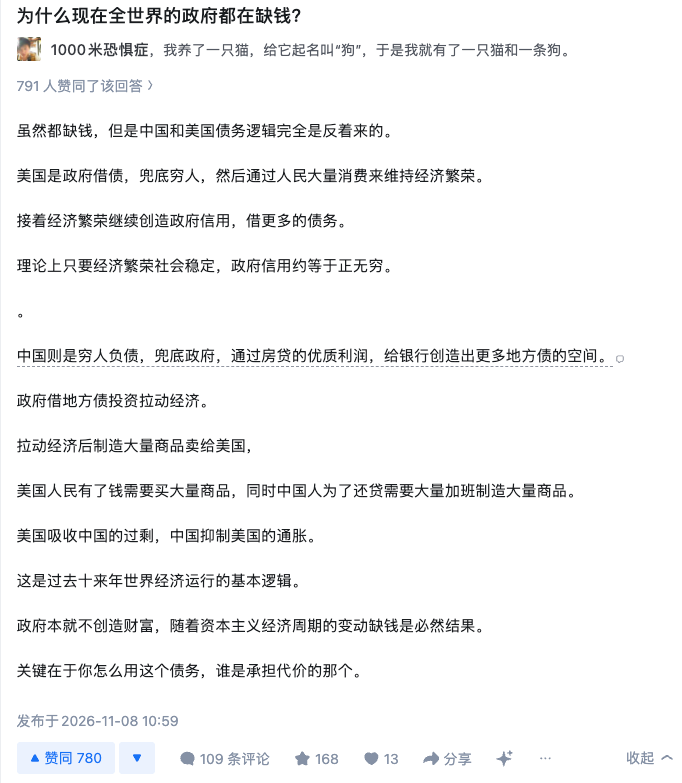
Both are short of money, but the logic of debt in China and the United States runs in completely opposite directions.
In the U.S., the government borrows to provide a safety net for poor people, then keeps the economy prosperous through large-scale consumer spending.
That prosperity keeps building the government's creditworthiness, allowing it to borrow even more.
In theory, as long as the economy prospers and society remains stable, the government's creditworthiness is effectively infinite.
In China, poor people take on debt to backstop the government. The attractive profits from mortgages give banks more room to finance local government debt.
The government borrows through local government debt to invest and stimulate the economy.
With the economy stimulated, China manufactures huge quantities of goods to sell to the United States,
Americans have money and need to buy lots of goods. Meanwhile, Chinese people need to work lots of overtime producing those goods to repay their loans.
The U.S. absorbs China's surplus, while China keeps U.S. inflation in check.
That has been the basic logic behind the world economy over the past decade or so.
Governments do not create wealth in the first place. Running short of money is an inevitable result of shifts in the capitalist economic cycle.
What matters is how you use that debt, and who ends up paying the price.
Author displayed as 知乎用户 CGEcFF, published October 24, 2026, at 14:54. No separate link to this answer was provided.
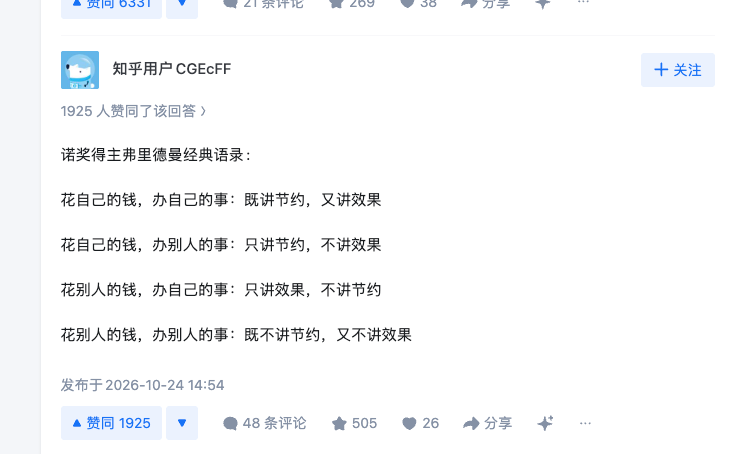
A classic quote from Nobel laureate Friedman:
Spending your own money on yourself: you care about both keeping costs down and getting results
Spending your own money on someone else: you care about keeping costs down, but not about results
Spending someone else's money on yourself: you care about results, but not about keeping costs down
Spending someone else's money on someone else: you care about neither keeping costs down nor getting results