Why Are Some People in China So Afraid of “Winning”? (Zhihu Replies)
The following are translations of eight replies to the Zhihu question “Why are some people in China so afraid of ‘winning’?”, presented in the order of the supplied screenshots. Author names and publication or edit times follow the screenshots; missing times have not been filled in. No links to the question or individual answers were provided.
The replies distinguish actual wins from 赢学, rendered here as “triumphalism”: declaring victory regardless of whether ordinary lives improve.
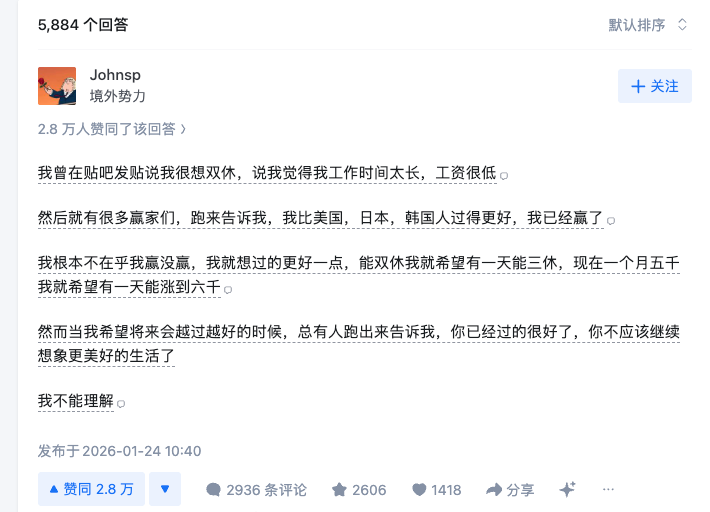
Zhihu user Johnsp, published January 24, 2026, at 10:40:
I once posted on Tieba saying I really wanted two days off a week, that I thought my working hours were too long and my pay too low
Then a whole bunch of “winners” came along to tell me I was living better than people in the United States, Japan and South Korea, and that I'd already won
I couldn't care less whether I've won or not. I just want to live a little better. If I get two days off, I'll hope to get three someday. If I'm making five thousand a month now, I'll hope it can rise to six thousand someday
But whenever I hope life will get better in the future, someone always pops up to tell me I'm already living very well and shouldn't keep imagining a better life
I don't understand
Zhihu user 风月; the screenshot does not show a publication or edit time:
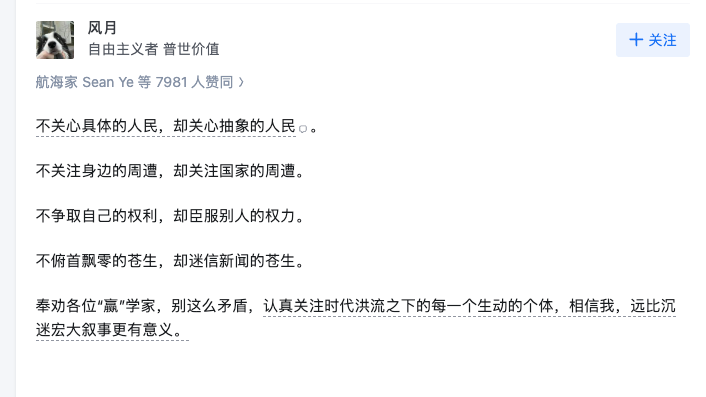
You don't care about actual people, but you care about “the people” in the abstract.
You don't pay attention to what's happening around you, but you pay attention to what's happening around your country.
You don't fight for your own rights, but you submit to other people's power.
You won't humble yourself before people cast adrift, yet you put blind faith in the “people” presented in the news.
A word of advice to all you scholars of “winning”: stop contradicting yourselves. Pay real attention to every living individual swept along by the currents of our times. Believe me, that means far more than getting lost in grand narratives.
Zhihu user 子非鱼, published February 4, 2026, at 19:56:
When “we're losing” rhetoric has the upper hand, there's still room for improvement;
When triumphalism has the upper hand, there's still room for decline

Zhihu user Harunobu, published March 1, 2026, at 15:25:
Whenever the boss wants to win, I have to work overtime. If the boss wants to win in style, I have to work overtime day and night.

Zhihu user 伦敦贾跃亭, published February 3, 2026, at 01:44:
Because my family really did pay the price for “ten thousand jin per mu”
The phrase 亩产万斤 describes a crop yield of ten thousand jin per mu—about five metric tons per 667 square meters.

Zhihu user 掂過碌蔗, published April 11, 2026, at 10:51:
Doctor: “A small tumor in your brain has worsened. The outlook isn't good!”
“Why don't you talk about all the things that are good about him? Why fixate on one tumor? Aren't his heart, liver and kidneys all doing fine? Why don't you mention that the patient in the next bed is paralyzed? Stop spreading negativity, doctor😡!”

Zhihu user 香坊大呲花, edited February 20, 2026, at 19:21:
It's simple: people aren't afraid of winning. They're afraid of triumphalism.
What's the difference? Here's a small example.
Your work schedule goes from 996 to 965. That's winning.
You work 996, but someone tells you even 996 is better than dropping below the “execution line.” That's triumphalism.
The difference is that winning can make your life better, while triumphalism won't. Some people will even try to shut you up when you complain.
This is a real example I saw under a question about the “execution line.”
“996” means working from 9 a.m. to 9 p.m., six days a week; “965” means 9 a.m. to 6 p.m., five days a week. The “execution line” (斩杀线) is used here as a metaphor for the point at which someone's livelihood collapses.

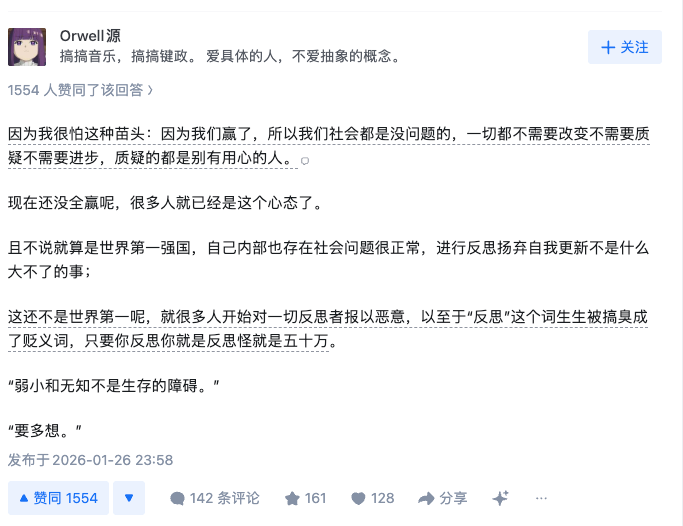
Zhihu user Orwell源, published January 26, 2026, at 23:58:
Because I'm very afraid of this line of thinking taking hold: since we've won, there are no problems in our society. Nothing needs changing, nothing needs questioning, nothing needs improving, and anyone who questions things has ulterior motives.
We haven't even won across the board yet, and plenty of people already think this way.
Even if we were the world's most powerful country, it would be perfectly normal to have social problems at home. Reflecting, critically reassessing and renewing ourselves would be no big deal;
We're not even number one in the world yet, and already plenty of people are treating anyone who reflects critically with hostility. They've managed to turn “self-reflection” itself into a dirty word. As soon as you reflect, you're a “reflection freak,” a “500,000.”
“Weakness and ignorance are not barriers to survival.”
“Think more.”
The original uses 五十万, literally “500,000,” as an insinuation that someone is a foreign agent.